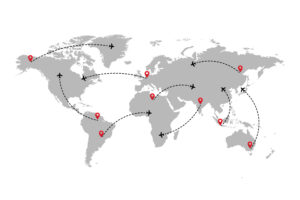
The most important cross border ecommerce trends are not changes to the storefront. They are operational shifts that connect checkout, compliance, fulfillment, and shipping into one model. Those shifts are landed cost transparency, deeper localization, regional fulfillment, earlier customs compliance, carrier orchestration, fiscal structures built into market entry, and operational intelligence.
A global storefront can attract demand in a new market overnight. However, delivering the order at the promised price, with the right tax treatment, documents, and return path, is where expansion succeeds or loses margin. As a result, growth is becoming less about opening more countries and more about building a repeatable operating model.
This guide covers seven trends. For each one, you will see what is changing, why it matters, and a first move you can make.
The seven cross border ecommerce trends at a glance
| # | Trend | From | To | First move |
|---|---|---|---|---|
| 1 | Landed cost transparency | Surprise charges at delivery | Duties and taxes shown at checkout | Calculate landed cost from shipment data |
| 2 | Localization beyond currency | A translated store | Local payment, delivery, tax, and returns | Map each market’s expectations |
| 3 | Regional fulfillment | One domestic warehouse | Inventory placed by market economics | Score markets before moving stock |
| 4 | Earlier customs compliance | Fixes after the border | Controls at setup and checkout | Clean your top SKU data |
| 5 | Carrier orchestration | More carriers, more chaos | Rules that pick the service per order | Rank services by outcome |
| 6 | Fiscal structures | An export shipment only | An entry model designed per market | Choose the model before launch |
| 7 | Operational intelligence | Total international revenue | Profit and service by market | Track lane level metrics |
Trend 1: Landed cost transparency becomes a conversion requirement
International shoppers are less willing to accept surprise duties, taxes, and carrier collection fees at delivery. According to Baymard Institute, 40% of shoppers who abandon a cart cite extra costs that are too high. Therefore, a product that looks competitive can lose the sale at the last step, or lose the customer at the door.
Delivered Duty Paid models are gaining ground because they calculate and collect duties and taxes at checkout. The benefit goes beyond a cleaner buying experience. Finance, customer service, and logistics also gain more predictable economics per shipment.
Accuracy decides whether this works. Duty treatment varies by classification, declared value, origin, destination, and local thresholds. As a result, landed cost belongs in core commerce infrastructure, not in a shipping add on applied after the order.
From surprise charges at delivery to a final price at checkout.
First move: calculate landed cost from the same product data that creates the shipment, and review the variance by market. Our guide to the $400 billion problem in international checkout shows why.
Trend 2: Localization now extends beyond currency
Local currency matters, and 92% of global consumers prefer it, according to Capital One Shopping. However, currency is only one part of a local transaction. Shoppers also expect familiar payment methods, delivery options that match local norms, clear tax presentation, and return instructions they can act on. Payment habits differ widely, since digital wallets already account for 56% of global ecommerce value, according to Worldpay.
This creates a practical choice for operators. You can run one global checkout with local capabilities, or you can build market specific stores.
| Approach | Strength | Best when |
|---|---|---|
| One global checkout with local capabilities | Speed, reporting, and governance | Most markets, especially at early and mid stages |
| Market specific storefronts | Distinct assortment, promotions, entities, and regulation | High volume markets with their own requirements |
The operating priority is consistency. A buyer in Mexico, the United Kingdom, or the European Union should receive an accurate price and a credible delivery promise, without disconnected workflows behind the scenes.
From a translated storefront to a transaction that feels local.
First move: map each market’s payment, delivery, tax, and return expectations before you change the storefront.
Trend 3: Regional fulfillment replaces the one warehouse assumption
Shipping every international order from a domestic warehouse works well for testing a market. It limits inventory exposure and enables a fast launch. However, the model gets expensive and slow as order density rises, especially for categories with frequent returns or high shipping costs. Providers report that direct cross border delivery typically takes 5 to 15 business days, while local fulfillment often delivers in 1 to 3.
Regional fulfillment places inventory closer to demand. It can lower last mile costs, shorten transit, and reduce customs events on individual orders. In return, it adds allocation rules, local invoicing, fiscal structures, replenishment planning, and visibility across nodes.
The critical shift is treating inventory placement as a commercial decision, not as a warehouse count.
| Market profile | Better fit |
|---|---|
| Strong demand but low margin | Direct cross border shipping |
| Repeat customers and predictable volume | Local stock sooner |
| A new market with uncertain demand | Direct shipping to validate first |
From one domestic warehouse to inventory placed by market economics.
First move: score each market on sales velocity, margin, delivery expectations, return rate, and import treatment before you commit stock. Our guides on when to use regional fulfillment and multi country inventory planning explain how.
Trend 4: Customs compliance moves earlier in the order flow
Teams often blame carriers for customs friction. In fact, many failures start upstream. Incomplete product data, inconsistent values, incorrect HS codes, missing importer details, and weak origin records all create delays or penalties. According to GingerControl, classification errors account for about 42% of penalty cases.
Operators are moving controls closer to product setup and checkout. That means cleaner classification data, restricted product rules checked before the sale, and commercial documents built from the same source as the order. As a result, fewer fixes happen after a shipment has already entered the network.
Rules also change market by market. Tax registration, marketplace obligations, low value shipment rules, consumer disclosures, and invoice requirements cannot live in spreadsheets at scale. Instead, build governance into the workflow, with clear ownership across ecommerce, tax, finance, product, and logistics.
From fixes after the border to controls at product setup and checkout.
First move: audit your top SKUs for a specific description, an HS code, an origin, and a declared value. For a deeper look, read [inserir link do post “How to Reduce Customs Delays at Scale”].
Trend 5: Orchestration wins over carrier sprawl
Adding carriers can improve coverage and pricing leverage. However, unmanaged expansion creates new problems. Label formats, service rules, claims processes, tracking events, and surcharge structures all differ, so performance becomes hard to control across markets.
The stronger model is carrier orchestration. Rules select the service by destination, parcel characteristics, promised delivery date, landed cost model, and commercial priority. This goes beyond rate shopping, because the rules should also use real delivery outcomes, clearance performance, exception rates, and return experience.
| Order profile | Routing rule |
|---|---|
| Premium order | The fastest available service |
| Lower margin order | A service that protects contribution margin with acceptable delivery performance |
| High value or restricted goods | A service with stronger tracking and clearance support |
A low headline rate is not a saving if it produces delayed parcels, customer contacts, and replacement orders.
From more carriers, more chaos to rules that pick the service for each order.
First move: rank your carrier services by outcome, not by headline rate. For the selection criteria, read [inserir link do post “Carrier Selection for International Shipping”].
Trend 6: Fiscal structures become part of market entry design
As brands grow, the question shifts from “Can we ship there?” to “What is the most efficient way to sell there?” In many markets, the answer involves more than an export shipment. It can require local invoicing, tax collection, an importer of record strategy, or a B2B2C structure that supports compliant domestic delivery.
These choices shape the customer experience and the unit economics. They decide who carries import responsibility, when tax is due, how returns are processed, and whether the buyer receives the documents the market expects.
| Structure | What it gives you | Best fit |
|---|---|---|
| Export shipment, DAP | Low setup, with the buyer handling import | Market tests and low volume |
| DDP with an importer of record strategy | Price certainty, with the seller handling import | Priority markets |
| B2B2C structure | Compliant domestic delivery and local invoicing | Markets where you need local selling without an entity |
| Local entity | Full control over stock, invoicing, and returns | Scale in an established market |
No structure fits every country or product. The right one depends on volume, product value, entity footprint, tax exposure, and the control you need over the post purchase journey.
From an export shipment only to an entry model designed for each market.
First move: choose the entry model before launch, because rework after demand arrives costs more. Our guide to VAT registration workflow automation shows how to keep registrations under control.
Trend 7: Operational intelligence becomes a growth lever
International expansion creates data across storefronts, payment providers, carriers, warehouses, customs processes, and support. When those sources stay fragmented, teams spend their time reconciling reports instead of acting on them.
Leading operators measure profit and service by market, not just total international revenue. They track landed cost variance, transit time by lane, delivery exception rates, duty recovery, return reasons, and support contacts. The value comes from tying each insight to an action.
| Signal | Likely response |
|---|---|
| Repeated customs holds on a lane | Better product data, or a different import model |
| Reliable delivery but weak conversion | Checkout localization or clearer duty presentation |
| Returns eroding margin | A local consolidation path |
From total international revenue to profit and service by market.
First move: build a scorecard by lane, with the six measures above. Our guide to the best metrics for cross border operations shows how.
Which trend should you tackle first?
Start with the symptom you already see. Each one points to a trend.
| If you see | Start with |
|---|---|
| Customers complain about surprise charges | Trend 1, landed cost transparency |
| Strong traffic but weak conversion in one market | Trend 2, localization |
| Slow delivery and costly returns | Trend 3, regional fulfillment |
| Shipments stalling at the border | Trend 4, earlier customs compliance |
| Cost and service that vary by carrier | Trend 5, carrier orchestration |
| No clear way to sell in a new country | Trend 6, fiscal structures |
| No clear view of which market earns money | Trend 7, operational intelligence |
Frequently asked questions about cross border ecommerce trends
What are the biggest cross border ecommerce trends?
Seven operational shifts stand out: landed cost transparency, localization beyond currency, regional fulfillment, earlier customs compliance, carrier orchestration, fiscal structures in market entry, and operational intelligence.
What is landed cost?
Landed cost is the full cost of delivering a product to the buyer. It includes the product price, shipping, duties, import taxes, and fees. Therefore, showing it at checkout removes the surprise at delivery.
Is DDP better than DAP?
Not always. DDP gives price certainty and a smoother buyer experience, while DAP lowers upfront complexity. Choose by market expectation, order value, margin, and your ability to run local obligations.
When does regional fulfillment make sense?
It makes sense when demand is steady, margin supports local stock, and delivery speed limits conversion. A new market with uncertain demand is often better served by direct shipping first.
What is carrier orchestration?
Carrier orchestration is a set of rules that selects the service for each order, based on destination, parcel, promised date, landed cost, and priority. It goes beyond rate shopping.
The common thread across these trends is control. Global growth gets harder when each new country adds another checkout provider, tax process, warehouse, carrier contract, and manual exception queue. In contrast, it gets manageable when those functions work as one system with market specific rules. To see where your operation stands on each trend, book a call with ShipSmart and bring your top markets.