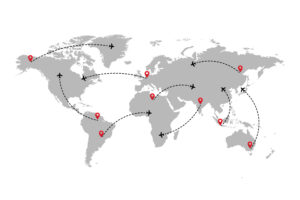
A brand can be in stock globally and still lose a sale locally. The issue is rarely total inventory. Instead, it is where that stock sits and how fast it can move to demand. Inventory pooling treats stock across locations as one coordinated resource, not as separate country silos.
Until November 13, 2026, ShipSmart offers one month of free storage at its Miami fulfillment. This guide explains the pooling logic first. Then it shows how to use that free month as a low commitment test of a Miami position before Black Friday.
Speed matters at peak. Shopify merchants passed 20 million cross border orders during the 2025 Black Friday Cyber Monday weekend, a first. Meanwhile, 48 percent of shoppers abandon a cart when an unexpected cost appears, according to Baymard Institute. Inventory placed closer to the buyer helps on both fronts.
What is inventory pooling
Inventory pooling combines demand and stock coverage across products, channels, regions, or fulfillment locations. Instead of holding separate safety stock for every market, a business shares inventory to serve demand where it appears.
In its simplest form, one central fulfillment center ships internationally. More advanced models pool stock across regional hubs. Orders then ship from the best location, based on availability, destination, cost, tax treatment, carrier performance, and promised delivery date.
The logic is simple. Demand varies. When stock splits across many locations, each one needs its own buffer. When one pool serves several markets, variation partly cancels out. As a result, the business often holds less safety stock overall and still keeps a stronger in stock position.
Pooling does not mean centralizing everything. Design it around each market’s customer experience and economics. A fast moving SKU may need local stock. Lower volume products can stay in a shared hub until demand justifies a dedicated position.
Why pooling matters in cross border commerce
International growth creates a predictable tension. Customers expect local speed, while finance wants to avoid duplicating stock in every new market. Holding separate inventory in several countries improves speed. However, it also ties up capital and raises the risk of stranded stock.
Pooling offers a middle path. It supports market coverage without a full assortment and deep safety stock in every country. It suits brands with broad catalogs, seasonal demand, uneven order volume, or early stage market entry.
A well run pool also reduces stockouts, because inventory becomes visible across the network. It improves sell through, since units move toward live demand. Furthermore, it shows when a market has earned its own local position.
Finance and tax teams gain as well. Pooling gives a clearer basis for deciding where inventory is owned, imported, and invoiced. Stock should never move just because a warehouse has spare units. It must follow a compliant and economically sound route.
The core trade off, pooling versus local stock
Pooling cuts duplicated safety stock. However, it can lengthen the distance between stock and customer. That can mean higher parcel cost, longer transit, and more customs work when an order crosses a border.
Local stock does the opposite. It speeds delivery and can lower last mile cost. In return, it needs inbound planning, local storage, tax and entity decisions, and more working capital. It also risks slow units piling up in one location while another misses sales.
The right answer depends on velocity, order value, parcel profile, margin, and service expectations. A light, high margin product can stay centralized longer. A bulky or low margin product needs a closer position sooner. Most strong networks combine both. Core SKUs sit in hubs where demand is proven, and long tail products stay pooled.
Why a Miami position makes sense for pooling
Miami is a practical place to hold a pooled position. It serves US customers directly. It also sits close to Latin American and Caribbean demand. For a US brand, that means one location can support domestic orders and act as a base for buyers elsewhere in the Americas.
Ship Fulfillment receives your inventory, stores it, picks and packs orders, and ships through partner carriers. It also covers inventory management, inspection, palletization, and consolidation. See the Miami fulfillment page for the current service details.
Transit times depend on the carrier and the destination. Confirm them with the team for your own lanes before you set delivery promises.
The offer: what is included and what is not
The campaign is called “1 Month of Free Fulfillment Storage. Zero Risk. Full Speed.” The name is catchy. The terms are what matter, so read them closely.
| Item | How it works |
|---|---|
| Free storage | 1 month, counted from the day your first volume enters the warehouse |
| Storage limit | A limit of boxes and SKUs applies, set in the offer terms |
| Picking and packing | Charged as usual |
| Freight | Charged as usual by partner carriers |
| After 30 days | The account converts to the paid plan, with advance notice |
| Cancellation | No penalty until day 28 |
| Offer deadline | Valid until November 13, 2026 |
In short, the free month removes one cost line, storage. Inbound freight, picking, packing, and outbound shipping still cost money. That is useful, because it lets you see your real unit economics while storage costs nothing.
Market benchmarks put standard US 3PL storage between 15 and 25 dollars per pallet per month, and many providers add 15 to 30 percent in Q4. These are market figures, not ShipSmart pricing. They show why a free storage month matters most during peak.
How to use the free month as a real test
Treat the 30 days as an experiment with a decision at the end.
First, pick a small set of core SKUs with proven demand, within the box and SKU limit. Avoid long tail items. Their sell through is too slow to teach you anything in a month.
Second, define routing rules before the stock arrives. Decide which orders ship from Miami and which keep shipping from your current origin. Without a rule, the test mixes two operations and shows nothing.
Third, send the first volume and note the entry date. The 30 days start there. If the stock enters in mid November, the window can cover Black Friday, which falls on November 27, 2026. Confirm your inbound date with the team.
Fourth, measure weekly. Track in stock rate, order fill rate, delivery time against the promise, cost per order including picking, packing, and freight, split shipment rate, and return rate. Also compare these numbers with orders shipped from your current origin.
Finally, decide before day 28. Review the numbers around day 25. If the Miami position beats your current setup on speed and total cost, convert to the paid plan. If it does not, cancel without penalty.
Where pooling often breaks down
Pooling fails when operations are pooled but pricing and compliance stay fragmented. A brand may ship from a regional hub while checkout shows the wrong duty and tax treatment. The order ships, yet it still creates friction, unexpected fees, and delays.
Pooling also cannot fix weak demand planning. Shared stock absorbs normal variation. It does not solve persistent forecast error or a catalog too broad for the available capital.
Returns need deliberate design too. Sending every return back to its origin can destroy the economics of a pooled model. Set clear rules for consolidation, resale, refurbishment, and liquidation. As we covered in our breakdown of why Black Friday is your operation’s biggest stress test, every weak point shows up at the same time.
Who this offer fits, and who should wait
The offer fits brands with proven SKUs, US or Americas demand, and the ability to send a first volume soon. It also fits teams that want to compare a US position against direct shipping with real numbers.
On the other hand, it fits less well when demand is uncertain, when the catalog is mostly long tail, or when inbound stock cannot arrive in time. In those cases, a smaller test or a later start makes more sense. Our guide to import management software categories in 2026 explains how pricing, documents, and fulfillment should share one data source.
Frequently asked questions about the Miami fulfillment offer
What does the free month include?
It includes one month of storage at the Miami fulfillment, within a limit of boxes and SKUs set in the offer terms. Picking, packing, and freight are charged as usual.
When does the 30 day count start?
It starts when your first volume enters the warehouse, not when you sign up.
What happens after 30 days?
The account converts to the paid plan, with advance notice. You can cancel without penalty until day 28.
Until when is the offer valid?
The offer runs until November 13, 2026.
Is inventory pooling right for every brand?
No. It works best for brands with proven demand across several markets. Brands with uncertain demand should start smaller.
Inventory pooling works when each unit sits where it earns the best service level and margin. If you want to test a Miami position before Black Friday, see the full ShipSmart Black Friday offer, or book a Black Friday readiness call and confirm the terms with the team.