
A new country storefront can go live in a few weeks. Keeping it profitable after the first spike in demand is the harder test. An international storefront rollout has to connect what the customer sees with the decisions nobody sees. Those decisions determine whether orders clear customs, taxes reconcile, delivery promises hold and margins stay intact.
For international commerce teams, the goal is not to open as many storefronts as possible. Instead, it is to build a market entry model that repeats under control. That means treating localization, fiscal setup, checkout, fulfillment and post purchase operations as one operating system.
A storefront that holds up is one where the checkout promise, the customs data and the finance close all tell the same story.
Build the international storefront rollout around market economics
Market selection should start with the commercial case, not with how easy it is to translate a storefront. A country can show strong traffic or social demand and still carry duty exposure, delivery costs, return complexity or local tax obligations. Any of them can change the economics. On the other hand, a smaller market can be more attractive when an existing fulfillment node can serve it with predictable landed costs.
Model the customer price and the brand margin before you commit to a launch. That means looking at product classification, duty rates, import taxes, carrier costs, payment fees, return rates, packaging requirements and the cost of placing inventory. The answer changes by product category and order value. For example, apparel, cosmetics, electronics, supplements and bulky goods each raise different customs, regulatory and return questions. This guide to the real cost of an international order shows how those pieces add up.
A practical rollout starts with a short list of priority markets. The right first wave usually shares operational traits, such as compatible inventory flows, similar shipping lanes, manageable tax treatment and enough demand to justify the localization investment. Opening every available country at once creates a wide surface for exceptions without teaching you much.
Define the operating model before configuring the storefront
The same localized storefront can sit on top of very different commercial models. A brand can ship cross border from its home market, use regional fulfillment inventory or sell through a local fiscal entity. It can also mix these models by country and product line. Each choice affects delivery speed, customs clearance, invoicing, tax collection, consumer rights and working capital.
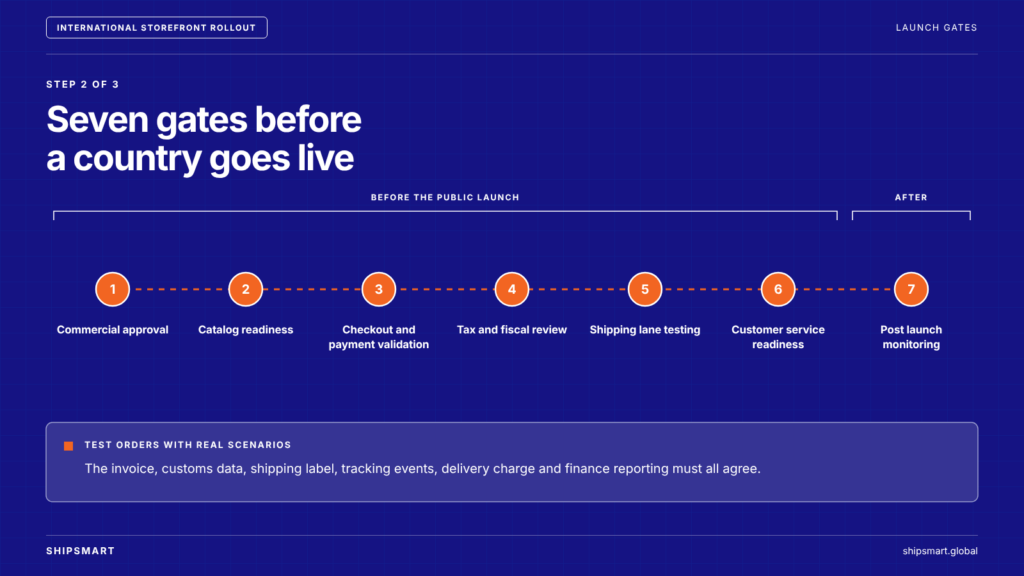
Cross border shipping is an efficient way to test demand with little inventory commitment. The tradeoff is usually longer transit time and more sensitivity to customs performance. Regional or in country fulfillment can improve delivery speed and reduce last mile cost. However, it needs inventory planning, local operational capability and clearer procedures for returns. No model wins everywhere, so the choice depends on order volume, product velocity, margin and local customer expectations. The guide to warehouse order routing for global fulfillment goes deeper on this choice.
Make this decision early, because it shapes the storefront promise. Delivery estimates, shipping options, returns language and final pricing must reflect the real fulfillment model. Otherwise, a storefront that advertises local speed while relying on an unpredictable lane loses trust quickly.
Localize the transaction, not just the language
Translation is the visible part of localization. Yet it is rarely what decides conversion or satisfaction after the purchase. Customers need to understand the total price, pay with familiar methods, see a credible delivery commitment and know whether duties and taxes are included.
A localized multi currency checkout should show a clear amount in the customer’s preferred currency and a consistent final charge. Currency surprises, unclear duty treatment and unexpected carrier collection requests cause avoidable abandonment and support volume. On higher value orders, they can also lead to refusals at delivery, which leave the brand with return freight and unrecoverable costs. This guide on localizing checkout currencies by market covers the details.
The checkout must also tell duties paid orders apart from duties unpaid ones. Delivered Duty Paid (DDP) can offer a cleaner customer experience, because taxes and duties are calculated and collected before shipment. It also gives the brand more control over the landed cost promise. However, DDP needs reliable product data, destination specific calculation logic and the right customs and fiscal process behind the transaction. The International Chamber of Commerce explains the difference between DAP and DDP, and this article shows why DDP, labeling and customs documents need one flow.
In some markets or categories, a duties unpaid model can still make commercial sense. What matters is transparency: the customer should understand what they owe before buying. The short term conversion gain from vague pricing is often wiped out by disputes, failed deliveries and wasted acquisition spend.
Product data is a launch dependency
Customs outcomes depend on the quality of the data attached to each order. Product descriptions, Harmonized System classifications, declared values, country of origin, weights and regulatory attributes should live as operational data. They do not belong buried in merchandising copy or in spreadsheets owned by a single team. The World Customs Organization offers a clear overview of the Harmonized System, and this guide covers HS code practices for global commerce.
Weak product data leads to inconsistent duty calculations, customs holds and manual work. It also distorts how profitable each market looks. Review the catalog before every launch, especially when the assortment includes regulated goods, bundles, promotional items or products with more than one country of origin. This is also where commerce, tax, logistics and product teams need a shared launch process. Without a common source of truth, inconsistencies appear at the border or at the finance close.
Design shipping for exceptions, not ideal transit times
Carrier selection should not rest only on a quoted delivery window. International shipping performance depends on pickup reliability, export handling, customs brokerage, destination handoff, tracking quality, address coverage, return capability and how well the carrier resolves exceptions. For more on this, see carrier selection for international shipping.
A single carrier can work for a low volume test. As order volume grows, shipping orchestration becomes more valuable. Routing rules can select services by destination, basket value, product type, delivery promise and service availability. As a result, the operation depends less on one network and holds up better during peak periods or regional disruptions. The article on multi carrier shipping covers this step.
The most useful shipping metrics go beyond average transit time. Track the share of orders delivered within the promised window, the customs hold rate, first attempt delivery success, the delivery exception rate, refused shipments and returns to origin. Together, they show whether a lane is commercially viable before poor experiences become a retention problem. It also helps to know what causes failed international deliveries.
Returns deserve the same attention as outbound delivery. A friendly return policy without a workable reverse logistics path becomes an expensive promise. Decide whether returns go to a local consolidation point, a regional hub or the origin warehouse. For low value goods, a refund without a return can cost less than international reverse shipping, so base that decision on product value, recoverability, fraud exposure and customer lifetime value.
Make compliance a configured capability
International expansion adds tax, invoicing, customs, consumer protection and product regulation obligations that vary by destination. Compliance should be designed into the transaction flow. It should not be a manual review after orders start shipping. The guide to cross border compliance is a good place to start.
The right fiscal structure depends on the market, the sales model, the fulfillment location and the role each entity plays in the transaction. For example, holding inventory locally can create tax registrations and reporting obligations that a pure cross border shipment never triggers. Selling to consumers through a local structure may require locally compliant invoices and specific tax logic. Marketplace activity can also bring considerations that differ from direct to consumer sales.
These are not details to postpone until scale. A weak setup can lead to held shipments, incorrect tax collection, delayed reconciliations and exposure that is far harder to fix after launch. Set clear ownership across tax, finance, operations and ecommerce. Then automate the rules wherever possible, such as duty and tax calculation, invoice generation, shipping documentation and routing.
Launch the international storefront rollout in controlled waves
A storefront should move through deliberate gates: commercial approval, catalog readiness, checkout and payment validation, tax and fiscal review, shipping lane testing, customer service readiness and post launch monitoring. This can feel slower than switching on a country selector. Even so, it is faster than repairing a broken customer experience across several systems.
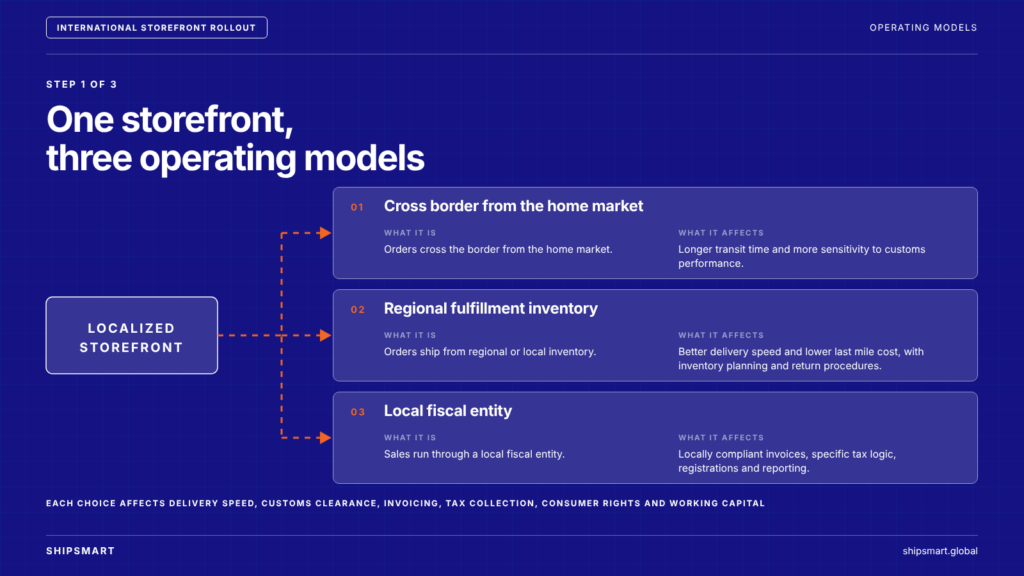
Before the public launch, place test orders that reflect real scenarios. Test different product classes, discount codes, high value baskets, remote postal codes, duty thresholds, address formats, payment methods and returns. Then verify more than acceptance. The invoice, customs data, shipping label, tracking events, delivery charge and finance reporting must all agree.
After launch, review market performance at the order level, because revenue alone can hide a poor operating result. Monitor landed margin variance, checkout conversion by payment method, delivery promise adherence, customs exceptions, support contacts per order, return reasons and cash to cash timing.
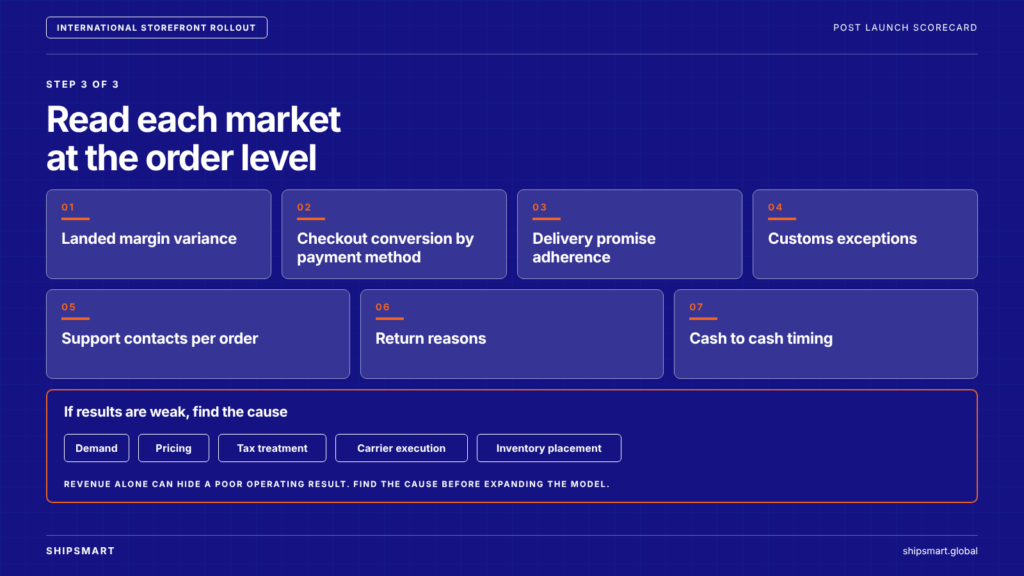
If performance is weak, find out whether the cause sits in demand, pricing, tax treatment, carrier execution or inventory placement. Do that before you expand the model.
What a platform adds to an international storefront rollout
A platform such as ShipSmart can centralize these functions across checkout, duties and taxes, fulfillment, shipping and fiscal operations. That reduces the need to assemble a separate operational stack for every new market. ShipSmart organizes these areas into products. Ship Pay covers checkout and payments, and Ship Tax & Duty calculates duties and taxes. Ship Fulfillment and Global Shipping handle the physical flow, while Ship Clear covers fiscal operations. The HS Code Intelligence tool supports the product data step.
The next step is rarely another broad expansion announcement. Instead, review the full order journey of one target market, from the product page to return or reconciliation. When that journey works under real operating conditions, the next storefront becomes a deployment, not a new project.
If you want a second pair of eyes on that review, talk to the ShipSmart team.
Frequently asked questions
What is an international storefront rollout?
It is the process of opening a storefront in a new country and connecting it to everything behind the screen: checkout, duties and taxes, fulfillment, shipping, compliance and post purchase operations. The goal is a model you can repeat, not a one time launch.
Should an international storefront rollout use DDP?
It depends on the market and the category. DDP gives a cleaner customer experience and more control over the landed cost promise, but it needs reliable product data and the right customs and fiscal process. A duties unpaid model can work when the customer understands what they owe before buying.