
A customer who sees a four day delivery promise cannot tell a carrier delay from a missing HS code or an unpaid import charge. They only see an order that failed to arrive. That is why customs clearance is a commercial control point, not a back office shipping task. It also affects conversion, delivery performance, support volume and margin in every destination market.
For brands that sell internationally, the goal is not just to move goods across a border. The goal is to make every shipment admissible, accurately declared, correctly taxed and released with minimal intervention. A controlled customs clearance process gives you predictable landed cost, reliable delivery and a market entry that scales. An improvised one gives you surprise fees, held parcels and a growing queue of exceptions.
Customs clearance, in short: send complete and consistent data on every order, decide who pays and who declares before the first label exists, and track holds by reason code. Then test each lane before you add volume.
What is customs clearance and what does it control?
Customs clearance is the process that declares imported goods to the destination country’s customs authority, assesses duties and taxes and authorizes entry. Depending on the market and shipment type, it can involve customs agencies, tax authorities, carriers, brokers and other regulators.
The declaration must match the physical goods and the commercial transaction. Authorities generally assess product classification, customs value, country of origin, quantity and importer details. They also check any required licenses or product documentation. A shipment can stall when even one of these fields is incomplete or inconsistent.
For ecommerce operators, customs clearance happens order by order, often at a volume that makes manual review impractical. A brand may ship consumer goods from a US fulfillment center to the European Union, move inventory into Mexico or deliver directly to customers in Brazil. As a result, each model gives the seller, the carrier, the importer of record and the local entity a different set of responsibilities.
The shipping label is only one part of the process. The outcome starts much earlier, with product data, checkout logic, tax setup and the commercial terms assigned to the order.
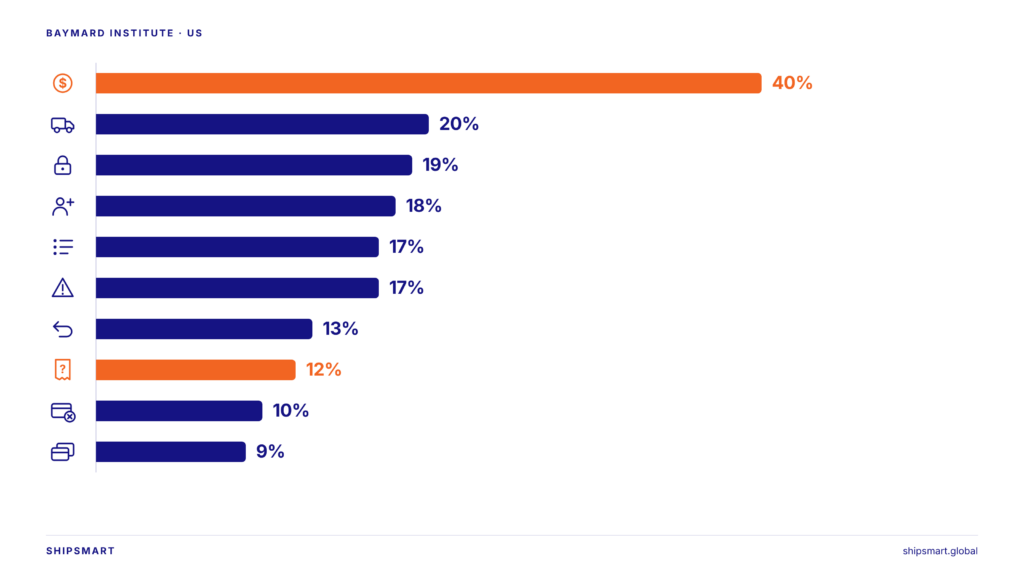
Cost clarity at checkout is one of those early decisions. Baymard Institute research on US online shoppers ranks extra costs as the top reason for abandoning checkout, at 40%. Those costs include shipping, tax and fees. Separately, 12% say they could not see or calculate the total order cost up front. The chart shows the main reasons, with the two cost reasons in orange. That ranking excludes shoppers who were only browsing.
Which data does customs clearance depend on?
Most customs friction traces back to poor transaction data, not to an unpredictable border event. Authorities need clear, defensible information. Generic descriptions such as accessories, samples or parts create ambiguity. So do inconsistent values between the order record, the commercial invoice and the customs declaration. The table summarizes the fields that matter.
| Field | What customs checks | Common failure | How to prevent it |
|---|---|---|---|
| Product classification | The HS code that sets duty treatment, restrictions and documents | A plausible code with no documented basis | Manage it at the SKU level and review new products, bundles and material changes |
| Customs value | The transaction value and any required additions | Values that differ between order, invoice and declaration | Use one value source and apply the rules of the import market |
| Country of origin | Where the product is considered made under the applicable rules | Using the shipping location or the packaging location | Keep origin tied to the SKU and inventory record |
| Product description | A clear description of the item | Generic labels such as accessories or parts | Write specific descriptions when you create the SKU |
| Quantity and importer details | The units declared and the party responsible | Fields that differ across systems | Capture them once at checkout and carry them to every document |
Product classification and description
Classification is the central requirement. The Harmonized System code determines duty treatment and can affect restrictions, documentation and eligibility for trade agreement preferences. The World Customs Organization offers an overview of the Harmonized System, and this guide covers HS code practices for global commerce.
So manage classification at the SKU level, with reviews for new products, material changes, bundles and market specific rules. A plausible code is not the same as a classification position that can withstand scrutiny.
Customs value
Customs value needs the same discipline. Under the WTO Agreement on Customs Valuation, the transaction value, meaning the price actually paid or payable, is the primary basis. Still, freight, insurance, assists, royalties, discounts and related party considerations can change the calculation, depending on the import market.
Declaring a lower value to reduce duty is not a growth strategy. It creates audit risk, penalties, holds and a record of noncompliance that makes future operations harder.
Country of origin
Origin is often misunderstood. It is not necessarily where the order shipped from or where the final packaging occurred. The applicable rules for the product and the manufacturing process decide it. For brands that source and fulfill from several countries, origin data must stay connected to the SKU and inventory record throughout the shipping workflow.
The same fields must agree across the order record, the commercial invoice and the customs declaration.
How do you build a customs clearance operating model?
A scalable model assigns responsibility before the first label exists. The seller decides who acts as importer of record and who pays duties and taxes. It also decides which party is liable for declaration accuracy and how records are kept. Define these choices by destination, product category, shipment value and fulfillment route.
A capable model also covers low value thresholds, local VAT or sales tax rules, marketplace obligations and fiscal representation. For example, a direct shipment can have a different tax treatment from inventory imported in bulk and sold through a local entity. Treating every cross border order as a standard parcel creates exposure when the real structure needs local registration, invoicing or tax remittance. The guides on cross border compliance, the IOSS number and the merchant of record show how these rules vary.
DDP or DAP: which model fits your customs clearance?
Delivered Duty Paid (DDP) is often the preferred experience for direct to consumer orders. The seller calculates and collects import charges at checkout, then arranges payment through the shipping and clearance process. Customers see a clearer landed cost and are less likely to abandon a parcel when an unexpected payment request arrives.
Delivered at Place (DAP) can be simpler to operate in some lanes, because the recipient pays import charges on arrival. But that simplicity often moves to the customer. The result can be delivery delays, refused shipments, reimbursement requests and a fragmented post purchase experience. The International Chamber of Commerce explains the difference between DAP and DDP.
| Question | DDP | DAP |
|---|---|---|
| Who pays import charges | The seller collects them at checkout and arranges payment | The recipient pays on arrival |
| What the customer sees | A clear landed cost before purchase | A payment request after the parcel arrives |
| What the seller needs | Reliable product data, destination calculation logic and a clearance process | A clear customer message and a plan for refusals and reimbursements |
| Main risk | Calculation or clearance errors that fall on the seller | Delays, refused shipments and a fragmented experience |
| Fits when | Prepaid collection is workable and the experience matters | Local practice supports it or prepaid collection is impractical |
DAP fits where local market practice supports it or where tax treatment makes prepaid collection impractical. It should be a deliberate model, not a default caused by missing capability. This article explains why DDP, labeling and customs documents need one flow.
How do checkout, tax and shipping work together before the border?
Clearance quality improves when one source of truth informs checkout, order management and shipping. The customer facing total should reflect the expected duty and tax outcome. Likewise, the commercial invoice should describe the order accurately. Finally, the carrier should receive the data it needs to clear the parcel electronically before it reaches the border.
Fragmented operations become expensive here. A tax calculator without current classification data produces an inaccurate landed cost. Likewise, a shipping system that cannot send complete customs data creates avoidable holds. And a localized checkout that does not support the right fiscal treatment looks compliant but fails in operation.
These guides show how to connect the pieces: integrating a landed cost API into checkout, estimating checkout duties for Shopify and VTEX and localizing checkout currencies. To see what the full bill looks like, read the total cost of an international order.
An integrated platform such as ShipSmart can coordinate these decisions. The HS Code Intelligence tool, also called Smart Classification, supports HS code classification. Ship Tax & Duty calculates duties and taxes in real time, and Ship Pay carries the result into a localized checkout. Global Shipping and Ship Fulfillment carry the same data into shipment creation and fulfillment, while Ship Clear covers fiscal operations in the destination country.
The value is operational control: fewer handoffs, consistent data and a clearer view of what each market requires before volume grows. To compare approaches, read this guide on how to choose import duty software and the explainer on duty and tax calculation software.
How do you manage customs clearance exceptions?
However, no process removes exceptions. Inspections, documentation requests, valuation questions and changing regulations are part of international trade. The advantage comes from detecting issues early and resolving them through defined workflows.
Track customs clearance performance by country, carrier, fulfillment origin, product category and reason code. The signals below point to likely causes.
| Signal | Likely cause | First action |
|---|---|---|
| Rising hold rate on one SKU | A classification or description problem | Review the classification record and the product description |
| Repeated duty adjustments | Incorrect landed cost logic | Compare estimates with actual entries and fix the rule |
| High refusal or return rate | Customers still asked to pay at delivery despite a prepaid duty promise | Check the order terms and the checkout message |
| Carrier requests proof of value | No clear owner for carrier requests | Name who responds, how fast and from which system |
Exception handling also needs ownership. If a carrier asks for proof of value or more product information, who responds and from which system? If the consignee must be contacted, does support have the right message and visibility into payment status? Without answers, a few delayed parcels can consume disproportionate time.
Keep a defensible document trail as well. Retain commercial invoices, proofs of payment, classification decisions, origin support, broker correspondence and import records according to each jurisdiction. Recordkeeping is not glamorous, but it turns customs clearance into a controlled compliance function instead of one off interventions. Clean records also support recovery programs such as duty drawback.
For tactics on holds, read how to reduce customs delays at scale, the ways to speed customs clearance and what causes failed international deliveries.
How do you scale customs clearance beyond the first shipment?
The first successful shipment into a new country proves a lane is possible. Yet it does not prove the lane is ready for volume. Scale adds more SKUs, promotions, fulfillment nodes, returns and edge cases around value, origin and tax treatment. Test the entire operating path before you expand a market.
| Test | What to confirm |
|---|---|
| Landed cost | Estimates match actual entries |
| Carrier and broker | They support the service level and the data transmission you need |
| Restricted products | You know which items need extra documents or are restricted |
| Clearance time | It is measured separately from linehaul transit time |
| Rule changes | A named owner turns them into product, checkout and shipping rules |
Measure clearance time separately from linehaul transit time, because each needs a different fix. The World Customs Organization’s Time Release Study is a recognized tool to measure the actual time required for the release and clearance of goods. You can borrow its logic for your own lanes.
Market conditions change too. Duty rates, de minimis rules, trade remedies, enforcement priorities and local tax requirements can shift with little notice. Teams need governance that tracks those changes and turns them into rules fast. The right process is not static documentation. It is an operating layer that adapts without forcing a rebuild each time a rule changes.
Programs that last treat customs as part of the customer promise. When product data, tax logic, fiscal structure and shipping execution are designed together, the border becomes a managed step in delivery. That control gives teams room to enter new markets with confidence and protect margin as volume grows. The guides on international ecommerce shipping and US fulfillment for international brands give wider context.
Frequently asked questions about customs clearance
What is customs clearance in ecommerce?
Customs clearance is the process that declares imported goods, assesses duties and taxes and authorizes entry. In ecommerce it happens order by order, so data quality decides the outcome.
Who is responsible for the declaration and the duties?
It depends on the operating model. The seller, the importer of record, the carrier or a broker can each hold a role. Define who declares, who pays and who keeps the records before the first label exists.
Which documents should you keep?
Requirements vary by country and product. For example, common items include the commercial invoice, proof of payment, classification decisions, origin support and any required licenses or product documentation. Keep them according to the rules of each jurisdiction.
What is the difference between DDP and DAP?
Under DDP the seller collects and pays import charges, usually at checkout. Under DAP the recipient pays on arrival. The choice shapes the customer experience and the volume of exceptions.
How long does customs clearance take?
It varies by country, carrier, product and data quality. Measure it separately from transit time and by lane, so you can find the cause of delays. This guide on customs clearance time goes deeper.
Can the process be automated?
Much of the data flow can be automated, from classification support to duty calculation and document generation. However, exceptions still need owners, defined workflows and a document trail.
What to do next about customs clearance
Start with one lane, the one with the highest volume or the most exceptions. Map the five data fields, choose between DDP and DAP on purpose and set reason codes for every hold. Then run test orders end to end and compare the estimate with the actual entry.
If you want a second opinion on a lane or on your exception workflow, talk to the ShipSmart team.