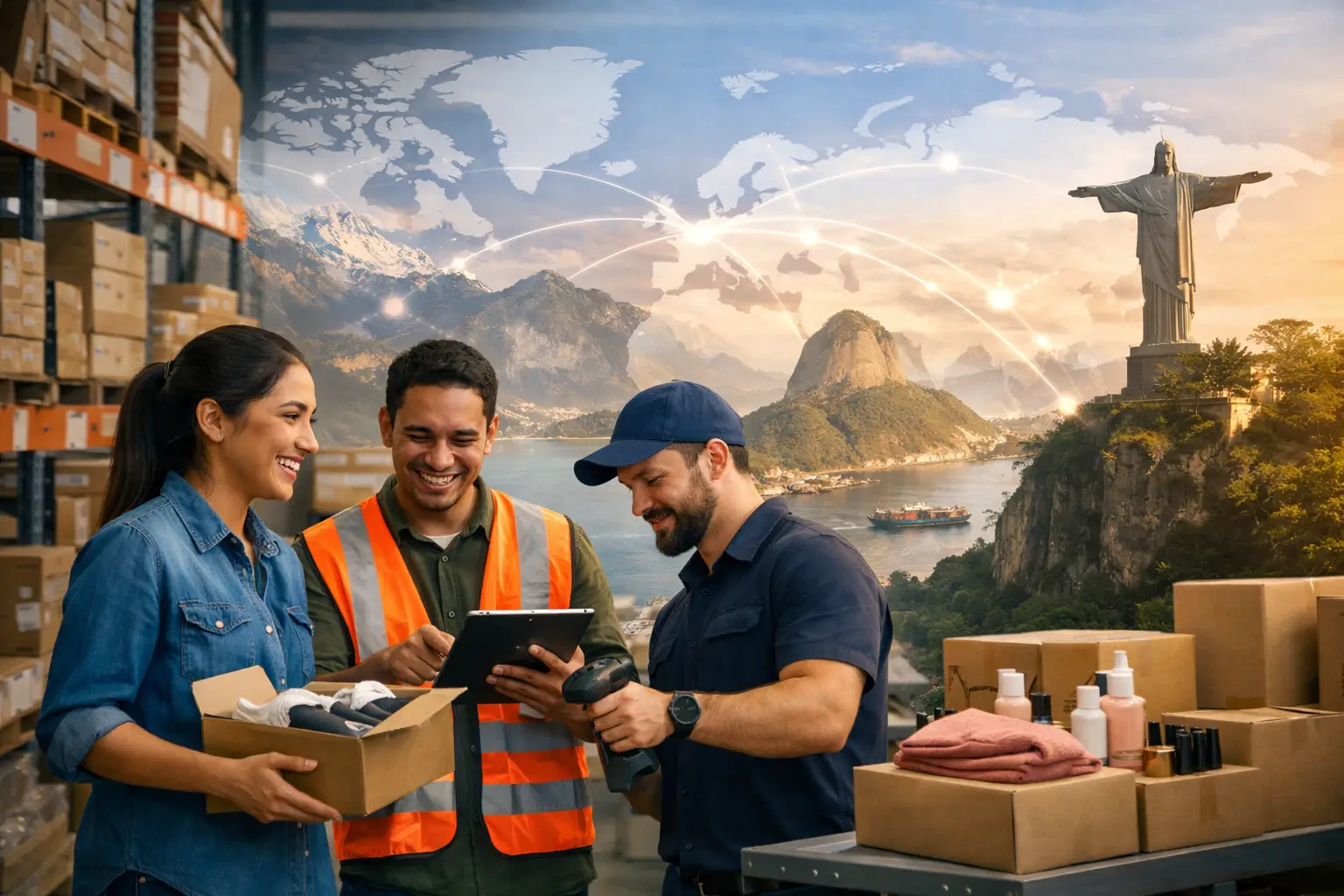
For Brazilian brands planning D2C e-commerce expansion into Europe and the United States, the Merchant of Record vs Local Entity decision shapes far more than legal structure. It affects tax exposure, checkout conversion, launch timelines, margin control, and how much operational complexity your team can absorb before growth slows down.
Most teams start with the same assumption: if a market matters, set up a local company. That can be the right move, but often not at the stage when you are still validating demand, pricing, fulfillment design, and return economics. In cross-border selling, speed matters, but speed without international compliance creates expensive cleanup later.
Merchant of Record vs Local Entity for Brazilian D2C
A Merchant of Record, or merchant of record model, is a structure in which a third party becomes the seller of record for the transaction in the destination market. That party typically handles local tax registration obligations tied to the sale, payment processing, invoicing requirements, and parts of consumer compliance depending on the setup.
A local entity model means your business establishes its own company in the US, an EU country, or both, then contracts directly for payments, tax registrations, fulfillment, and local operations. You own more of the stack, but you also own more of the risk and administration.
For Brazilian D2C leaders, this is not simply a legal preference. It is a question of operating model. Do you want a market-entry layer that reduces setup friction, or do you need full structural control because market volume, channel mix, and local obligations already justify it?
Tax compliance is usually the deciding factor
Tax and duty management is where many expansion plans either become scalable or become messy. In Europe, VAT treatment, IOSS considerations, import models, fiscal representation in some scenarios, and local invoicing requirements can create immediate complexity. In the US, the picture is different but not simpler. Sales tax nexus, marketplace rules, state-by-state thresholds, and import structuring all need active management.
With a merchant of record setup, much of that compliance burden sits with the provider operating the transaction layer. That reduces the number of registrations and tax processes your internal team needs to build on day one. It is especially useful when you are testing multiple markets at once or when finance and operations teams are lean.
With a local entity, you gain direct ownership of registrations, filings, payment flows, and customer contracts. That can improve long-term control, but only if your team is ready to manage international compliance as an operating function rather than a one-time setup task. Many brands underestimate how much ongoing governance this requires.
Operational speed favors Merchant of Record
If your immediate objective is market entry, Merchant of Record usually wins on speed. You can launch localized checkout, process transactions in-market, and support compliant cross-border flows without waiting on company formation, bank accounts, local tax IDs, and contracting cycles across multiple vendors.
That speed matters in D2C e-commerce expansion because the first phase is usually about learning. Which SKUs convert in Germany versus Florida? What landed cost threshold starts to hurt conversion? Is local inventory required, or can you serve demand from a regional hub? These are commercial questions, and they are easier to answer when infrastructure does not delay launch by months.
A local entity tends to make more sense when speed is no longer the priority. If you already know the market is strategic, expect meaningful recurring revenue, and need local hiring, wholesale relationships, or domestic fulfillment contracts in your own name, the setup time can be justified.
Margin and control can shift the decision
Merchant of Record is not automatically cheaper. It often reduces internal complexity and compliance exposure, but it also adds a service layer between your brand and the end market. Depending on the provider, pricing structure, payment setup, and scope of services, that can affect net margin.
Local entities often become more attractive as order volume grows. If you have stable sales, predictable tax obligations, and enough scale to justify in-house or outsourced finance, legal, and logistics support, owning the structure can improve economics and give you more control over customer data, payment relationships, and market operations.
This is where many serious operators land on a phased model. They use merchant of record to enter and validate, then shift selected markets to local entities once revenue, operational maturity, and tax footprint support it.
The real question is scalability
Scalable cross-border growth depends on more than registration status. It depends on whether your business can coordinate checkout localization, tax calculation, customs documentation, shipping orchestration, local delivery performance, and returns without building a different process for every country.
That is why the local entity versus merchant of record decision should be made alongside your broader operating stack. If your systems for payments, duties, shipping, and fulfillment are fragmented, a local company will not fix that. It may actually expose the weakness faster.
For many Brazilian brands, the strongest path is not ideological. It is staged. Start with the model that gets you compliant and live quickly. Measure conversion, CAC efficiency, landed margin, refund patterns, and delivery performance. Then decide where direct ownership creates strategic advantage.
When each model makes sense
Merchant of Record is usually the better fit when you are entering new markets, testing demand, working with a lean team, or trying to reduce tax and regulatory exposure early. It is also effective when your priority is getting to market with operational control but without building separate legal infrastructure in every country.
A local entity is usually the better fit when you have proven market demand, need long-term structural control, plan to hire locally, or require direct ownership of tax, payments, and commercial contracts. It can also be the right move when market-specific revenue is large enough to support dedicated finance and compliance workflows.
The strongest international operators treat this as a sequencing decision, not a binary belief. If the goal is profitable expansion, the right model is the one that matches your current stage, your tax risk tolerance, and your capacity to operate internationally without adding drag. Platforms such as ShipSmart are valuable when they let teams combine speed, international compliance, and execution discipline instead of trading one off against the others.